Showing posts with label Tax Planning. Show all posts

Enjoy PF Interest @9.5% tax free

Millions of PF account holders got a bounty of 9.5% interest for the year 2010-11. However there was a lack of clarity on the taxability of the Interest over 8.5% as the finance ministry had notified a interest exemption on PF deposits @8.5%.


In its notification No. 24/2011 dated 13th May,2011, the ministry of finance has revised the rate of interest notified under rule 6(b) of Part A of IVth Schedule to the Income tax act,1961 to 9.5%.

This clears the way of tax exemption on Interest Income from PF deposits @9.5% for the financial year 2010-11.

Read More!

Can I claim 80G deduction through my employer ?

Section 80 G of the Income Tax act provides for deduction from  Taxable income in respect of donation made to funds and charitable institutions. These institutions must have obtained the required approval from Income Tax department.


I am covering two aspects in relation to the 80 G deduction :

1. Can I claim 80 G deduction through my employer so that it forms part my Form 16 ?

2. What are the important points to be kept in mind while donations to the trusts and institution ?


Claiming 80G deduction through employer permissible

As per clarification provided on Income Tax department website, deduction under Section 80G can be claimed through employer only in case of contribution to the institutions specified.

No deduction should be allowed by the employer/DDO, from the salary income in respect of any donations made for charitable purposes. The tax relief on such donations as admissible u/s 80G will have to be claimed by the taxpayer in the return of income. However, DDOs, on due verification, may allow donations to the following bodies to the extent of 50% of the contribution:

a) The Jawaharlal Nehru Memorial Fund;

b) The Prime Minister's Drought Relief Fund;

c) The National Children's Fund;

d) The Indira Gandhi Memorial Trust;

e) The Rajiv Gandhi Foundation,

and to the following bodies to the extent of 100% of the contribution:

1) The   National   Defence   Fund   or   the   Prime Minister's National Relief Fund;

2) The Prime Minister's Armenia Earthquake Relief Fund;

3) The Africa (Public Contribution-India) Fund;

4) The   National   Foundation   for   Communal Harmony;

5) The Chief Minister's Earthquake Relief Fund, Maharashtra;

6) The National Blood Transfusion Council;

7) The State Blood Transfusion Council;

8) The Army Central Welfare Fund;

9) The Indian Naval Benevolent Fund;

10) The Air Force Central Welfare Fund;

11) The Andhra Pradesh Chief Minister's Cyclone Relief Fund, 1996;

(12) The National Illness Assistance Fund;

(13) The Chief Minister's Relief Fund or Lieutenant Governor's Relief Fund, in respect of any State or Union Territory, as the case may be, subject to certain conditions;

(14) The University or educational   institution   of national eminence approved by the prescribed authority;

(15) The National Sports Fund to be set up by the Central Government;

(16) The National Cultural Fund set up by the Central Government;

(17) The Fund for Technology Development and Application set up by the Central Government;

(18) The national trust for welfare of persons with autism, cerebral palsy mental retardation and multiple disabilities.

For donations made to fund/institutions other than mentioned above, you cannot claim the deduction through your employer.Hence you have to claim it while filing your return.


Keeps following in mind while making donations

1. Ensure that the fund /institution is approved by the Income tax department for deduction under this section. For check this, please ask for a photocopy of 80G eligibility certificate from the fund/institution.

2. Always ensure that the Receipt issued by the fund /institution carries the Name and address of the trust, your name, registration number issued to the trust and the validity period of the Registration. Also make sure to tally the the amount written in words and in figures.

Read More!

New Tax Code 2009 : Rewiring the Taxman

New Code aims to make tax laws and rates, Tax payer Friendly

taxfriendly I was recently discussing with a group of friends that the Indian tax rates structure needs a definite shift if the government wants voluntary compliance of tax laws and wants to increase the number of tax payers in the country. One of the discussion points was that government should introduce single tax rate of say 10% on the taxable income for individual tax payers and should do away with so many slabs and deductions. One suggestion was that income beyond 5 Lac should be taxed at 10% with no rebates or deductions whatsoever.

And here comes the New Direct Tax Code Bill, 2009  which attempts to simplify the lives of the tax payers.  Though the bill does not fulfill the wish-list of our discussion, it is surely a step towards providing a more tax-payer  friendly and simplified tax structure.

Following are the brief highlights of the New Direct tax code Bill,2009

  • The objective of the new tax code is to establish an efficient , effective and equitable direct tax structure in the country.
  • All direct taxes like Income Tax, Dividend distribution tax (DDT), Fringe benefit tax (FBT) and Wealth tax will be covered under this single tax code.
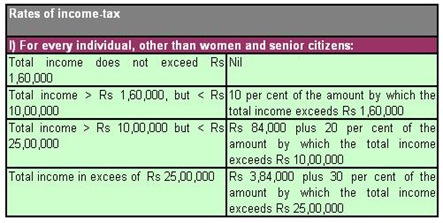
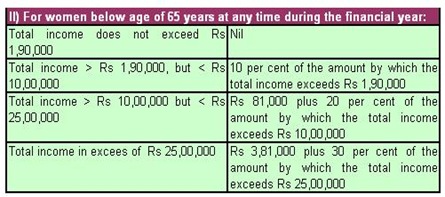
  • New Tax Rates will be applicable w.e.f. Financial year 2011 as under

newtaxrate1

newtaxrate2

newtaxrate3

  • Savings will now be taxed on EET basis. This means that Savings when done under designated schemes would be exempt from tax in the year the saving is done (First ‘E”). It will continue to be exempted together with the accumulations/accretions till the time they remain invested (that means till they are not withdrawn, this is Second ‘E’). The savings will be taxable at normal tax rates in the year in which withdrawal is made (this is ‘T’).
  • However, accumulated balances as on 31st March,2011 in the Provident Fund will not be taxed.
  • Deduction on account of savings has been increased from current 1 Lac to 3 Lac. However, since the new code doesn’t mention deduction in respect of Housing loan, the same may go.
  • Dividends will continue to remain tax free in the hands of Investors.
  • Capital Gains would now be taxed as income. The concept of short term and long term capital gains has been removed from tax perspective. Indexation benefit would be available on asset held for more than one year.
  • The indexation base has been changed from 1981 to 2000.
  • Since all capital gains are now taxed, Securities Transaction Tax (STT) has been abolished under the new tax code.
  • Salary received in form of perks, perquisite, LTA, Rent free accommodation, Medical reimbursement will now form part of Income and will be taxable.
  • Wealth Tax has been Re-introduced. Net Wealth in excess of Rs. 50 Crore  will be taxed @0.25%
  • In addition to deduction of Rs 3 Lac for notified savings schemes, Rs 15,000 deduction will be available for Medical Insurance Premium for self and family , and another Rs 15000 for parents. Up to Rs 50,000 can be claimed as deduction for treatment of disabled dependant , Rs 40,000 for prescribed diseases. Rs. 50,000 deduction would be available to handicapped and Rs 75000 for person with severe disability.

The New tax code is in discussion stage. You can give your comments and suggestions on the same by writing an email to directtaxescode-rev@nic.in

Keep a watch on this blog for posts related to implications of new tax code.

Download Discussion Paper

Download Direct Taxes Code Bill, 2009

Read More!

Tax Planning : Capital Gains on Sale of Shares

taxplanning

As an Investor, you often need to be aware of the Income Tax provision on capital gains tax liability arising on your Investment Decisions.  Awareness of these provisions would certainly help in minimizing the tax incidence on capital gains and hence effectively increasing your return on Investments. I will briefly explain you the concept and things to remember in a simple manner.

When does Tax liability arise ?

1. When you Sale shares, you attract capital gain tax based on period of your holding. A share if sold within 1 Year of buying will be taxed as Short Term Capital Gain. If you sale a share after holding it for more than 1 year, it will be treated as Long Term Capital Gain. For example if you bought 100 shares of Company “X” on 15th March,2008 and sold them on 1st March,2009 the period of your holding is less than 1 year and hence it would qualify for Short Term Capital Gain.  If you sell these shares after 15th March,2009, i.e., after holding it for more than 1 year, it will qualify as Long Term Capital Gain.

2. Short Term capital gain is taxable @15% while Long Term Capital Gain on Sale of Shares is Tax free ! Yes, the tax liability on Short Term and Long Term Capital gains makes it important for you to plan your moves carefully. In the above example, suppose you bought 100 shares of company ‘X” @ Rs.100 and Sold the same @Rs.150. If you sell these shares before 15th March , you will be liable to pay short term capital gain tax on the profit earned. In this case your tax liability will be Rs.750 i.e 15% of ( 100*(150-100)). However, you would have sold your shares on or after 15th March,2009,  the profit earned (Rs, 5000 in the above example) would be treated as Long term capital gain and would be Tax free.

3. You are liable to pay tax on Net Short term Capital Gains. This means that If you have earned Rs. 5000 on trading in Company “X” and booked a loss of Rs., 3000 on sales of shares of company “Y” (both should qualify as short term capital transaction), then your tax liability would be calculated on Rs. 2000 i.e., 15% of Rs. 2000. In other words, Short term capital gain can be offset by Short Term Capital Loss. However , you cannot offset a Short Term Capital Gain with Long Term Capital Loss. capital gain

4. Bonus Shares should be considered at Nil Cost of acquisition while calculating the gains. the period of holding should be computed from date of issue of Bonus shares.

5. You can claim cost of acquiring shares such as Brokerage charges, Demat charges while calculating capital gains.

Tax Planning Tips

1. Whenever you plan to sell a share, make sure to look at period of your holding. If you are earning profit on a transaction, you may decide to wait for few more days to convert a short term capital gain to a long term capital gain and enjoy tax free earnings.

2. At the end of financial year, say in the month of March, take a stock of all your holdings and see positions where you can book short term capital loss to offset short term capital gain that you have earned during the year. This way you would reduce your capital gain tax liability for the year. You can again take a position the stock on 1st April. This way you have saved paying tax on your capital gains for the year and still holding shares you have sold to book losses and hence offset the gain. This involves incurring transaction cost on buying and selling the shares and hence keep this in your mind while calculating your net gains.

3. If you are incurring huge loss on a position in any share, and if it is nearing a holding period of 1 Year, you would be better off to sell the shares as Long term capital loss cannot be offset with short term capital gain and hence selling it before 1 year holding period would help you to minimize your capital gain tax liability.

Update March 12th : Chinmay has rightly pointed out that Short term Capital Gain Tax has been increased from 10% to 15% with effect from Financial Year 2008-09. Investors should calculate Short term Capital Gain Tax @15% for their earning in year 2008-09. To avoid confusion I have updated the post accordingly.

Nitin had a query on treatment of capital gain on split Shares. When a company splits its shares, the value of the shares also gets allocated accordingly on the record date. Hence in this case the cost of these shares also gets proportionately divided. In this case , the period of holding will continue to be the same as period of holding of original shares.

For example suppose you bought 100 shares of company “X” with face value of Rs.10 @Rs. 100 Per share. Suppose the share is currently trading at Rs. 150. Now if the company announces a stock split by reducing the face value from Rs. 10 to Rs. 5, you will now hold 200 shares of the company and on the record date, the stock exchanges will publish a proportionately reduced price of the share say Rs. 74 in this case. Since your shareholding has increased from 100 to 200, your cost of acquisition per share has also come down from Rs. 100 to Rs. 50. Now you hold 200 shares of the company at Current price of Rs. 74. If you sell these shares your capital gain will be calculated as (200*(74-50). The period of holding will be determined based on the date of purchase of original shares.

Treatment of Shares related to Rights Issue

If a company has issued Shares through issue of Rights, the cost of acquiring these shares would be the actual price paid to acquire the rights. The period of holding would be counted from date of allotment of rights.

In case you transfer these rights instead of acquiring the shares, the cost of acquisition would be treated as “Nil” and the sale price of the transferred rights would be treated as capital gains.

Read More!

Top ELSS Fund for 2009 Tax Planning

The Taxman is calling again and investors are finding it difficult to decide if they should invest in a ELSS or not. Last Year has been a year of erosion of the NAV’s of the mutual funds and Tax Saving Schemes were no exception. Investors are not sure if they would get positive returns from Mutual funds. However, if you think from an Investment perspective of Three Years (lock-in period for ELSS investments), I would suggest that this is perhaps a good time to invest for a long term.  Here are the Top 5 Funds based on their performances -

 elss

However, one would see a return back to old favorites like PPF and FD’s and even NSC’s this time around. The lure of equity markets has surely taken a backseat and safety of capital has come to forefront of Investors. Investment Guru is of the view that ELSS still would emerge as a high return asset class for Tax saving purpose from the current levels and hence investors may consider allocating a part of their tax planning kitty to tax saving mutual fund schemes.

Read More!

Top 5 Tax saving Mutual Fund Schemes

Invest in these Schemes for best of Safety and Returns

Most of us have received emails from our HR/Admin asking us to submit the proof of Investments for the purpose of Tax Savings before a specified date and I am sure a lot of us are still in thinking mode as to where to invest for Tax savings. I had written a post last year (How to Invest for Tax Savings?) on the various avenues of tax savings and one more post on Top 5 tax saving funds. Well things have changed from last year in terms of stock market performance and it's right time to review which tax saving or ELSS (Equity linked saving schemes) should we invest in. Well, when I compared the tax saving schemes last year, I concentrated on the Top performing funds over a 5 year and 3 Year timeframe. We are currently going through such a phase in the stock markets which makes us think of saftey of our investments too. Hence I have introduced one more filter in terms of Risk profile of each fund (based on Standard deviation) and Yes, there are new entrants this time and postions have shuffled. Though we normally look at a Three year reutrn for determining which fund to invest in for tax saving purposes, I would suggest that we give some weightage to 1 year return also this time around. Why ? Because, this year had a good mix in terms of both sharp upside moves and sharp downside moves. So position as of 5th February would give an idea of how successful was the fund to manage this situation. we will have an idea of how the fund was able to withstand bouts of volatility. So let's have a look on the top 5 tax saving funds worth investing for purpose of claiming tax benefit under Sec. 80C of Income tax Act.

No. 5 Franklin India Taxshield


NAV : Rs. 174.1
Risk Rating : 3
Overall rating : 5


This is a new entrant in our Top 5 pipping Sundaram BNP on acount of excellent Risk Rating.
The fund has above 35,000 crore Avg. Mkt. capitalisation and equity exposure is more tha 97& of the assets. Top holdings include Reliance Industries, HDFC, L&T, ICICI Bank and Bharti Airtel. Financial Services, Technology and Energy are the top sectors where the fund is invested.

No. 4 Birla Equity

NAV : Rs. 76.47
Risk Rating : 5
Overall rating : 4


Another new entrant in our list of Top 5 tax saving schemes. Birla Equity offers excellent returns from all parameters,but standard deviation of 24.42 , this growth comes with comparatively high risk. The fund has 9394 crorr of AMC with high exposure in Engineering, Services and Financial service sectors. Top holdings include ABB, TRF, Gammon India, Welspun Gujarat and Goodyear India. Top 5 holdings constitutes 20% of its portfolio.

No. 3 HDFC Tax Saver


NAV : Rs. 179.05
Risk Rating : 4
Overall rating : 3


This fund was at No. 2 in the last year Top 5 funds ranking of Investment Guru. But has slipped to No. 3 this year. Well, the fund is second best in terms of 5 year return but scores poorly on 1 year return. Moreover, the Risk rating at 4 is the major reason for it slipping to No. 3 slot. So new filters had a impact on its ratings.

With Avg. market capitalisation of Rs. 23204 crore, the fund has top holdings in Basic Engineering, Financial Services and Energy sectors. Top 5 holdings include ICICI bank, L&T, ITC, Crompton greaves and Reliance Industries.

No. 2 HDFC Long term Advantage Fund


NAV : Rs. 114.99
Risk Rating : 1
Overall rating : 2


Well this chap has overshdowed its elder brother " HDFC Tax saver funds" and has emerged as the star performer from the HDFC stable. Top holdings include ICICI Bank, Reliance Industries, Blue Star, SBI and Crompton Greaves. But why, HDFC Tax saver fund has better 5 Year, 3 year and 1 Year retrun than this scheme, so why Long term Advantage fund at No. 2 ? Well in the year when investors are realising that saftey of investmnet is as important as the return, why would a fund that has got "THE BEST" risk rating should not stand at No. 2 in our rankings. With standard deviation of 19.84 this scheme has outperformed all the others in Top 5 by a big margin. So for those of us, who places safety as the utmost important factor, HDFC Long term Advantage fund offers the best place to invest. But wait, what if you are OK with second best in Safety and No. 1 in returns ......read on


No. 1 SBI Magnum Taxgain

NAV : Rs. 61.65
Risk Rating : 2
Overall rating : 1


The True leader in its class, SBI Magnum Taxgain has managed to remain at No. 1 even this year. With Standard deviation of 22.13 it has managed to be second best in terms of satefy of returns. In terms of performance it has beaten its nearest rival HDFC or any of the Other 4 Top picks by a big margin.

With Avg. mkt. cap of above 27000 crore and with equity to debt mix of 88:12, the fund has Reliance Industries, JP Associates, Welspun Gujarat, Reliance Communications and L&T as its major holdings. The Top Three sector in which the fund has exposure are Energy, Financial Services and Diversified.

My advice would be to go for SBI Magnum tax gain for claiming tax benefits under sec. 80 C of the Income Tax Act. The fund not only provides excellent safety in terms of "Low" risk but also offers highest return on all parameters among the Top 5 schemes.

For those who want capital appreciation can go for Growth option. Those like me who are willing to get regular liquidity in form of tax free dividends, opt for Dividend Payment option. Read More!

Basic guidelines for filing New Income Tax Return

ITR-1 to make life easy, ITR-2 may provide few challenges for Tax Payers

Gone are the days of saral form (People still doubt if they were really saral, but I bet you may have to think again after going through the new forms except ITR-1 !). The Income tax department has come with a new set of forms for assesse's to file their income Tax returns. The new forms are applicable w.e.f. 14th May,2007. The new ITR's are aimed at helping the income tax department monitor the quality of tax payers more closely and accordingly decide on measures to curb instances of Tax avoidances and bring tax rationality.

There are 8 different types of forms for different types of Tax payers. However, for readers I would focus on ITR-1 and ITR-2 unless I receive any specific request or query on the other forms. I believe ITR1 and ITR-2 would cover majority of the readers on the blog.

Here are the guidelines that tax payers have to keep in mind while deciding which ITR form to use and requirements for filing the returns
  • Every individual whose total taxable income exceeds Rs. 1 lac is required to file the retun of income. For females the limit is Rs. 1.35 Lac and for Senior Citizens it is 1.85 Lac.


  • Individuals who have only Salary Income and Interest Income have to fill their return in form ITR-1.


  • Individuals who do not have income from Business or profession, and have income from other sources are required to file return in ITR-2.


  • This means that all individuals who have income from house property or those those have income from capital gains will have to file ITR-2


  • Unlike previous years, there is no need to attach Form 16 (this is the form that your employers provides you detailing you Income declared to the employer and Tax deducted at source) with your return.


  • You are not required to attach any documents with your return.


  • You will need to provide certain details in the AIR (Annual information report) which is a section to be filled in the ITR's. I have given below the list of activities to be captured in AIR


  • The last date of filing your return is 31st July,2007. If you delay, you will be charged interest @ 1% for every month of delay.


  • You would be charged a penalty of R. 5000 in addition to the above interest if you file return for FY06-07 after 31st March,2008.


  • You have the option of filing the return online (will discuss this in detail later)

Annual Information Report (AIR)

AIR is the new requirement and is aimed at getting details of some significant transaction done by the individual tax payer in order to assess his tax profile. Eaelier the department used to get these informations from Banks, Credit card companies and Regisrtar's office.

Following are the key transactions to be reported in the AIR

  • Cash deposits totalling Rs 10 lakhs or more in a year in any savings account. If you have more than one savings account and none of the accounts individually has a balance of Rs. 10 Lacs, you don't need to provide this detail.


  • Payments totalling Rs 2 lakhs or more in the year made against bills raised in respect of a credit card. Again If you hold more than 1 credit card and you have not made any payment of above Rs. 2 Lacs on a single credit card, you don't need to provide any details in AIR.


  • Payment of Rs 2 lakhs or more for acquiring units of a mutual fund. Same logic applies here. You could have invested more than 2 Lacs in various mutual fund schemes, but report in AIR only if you have made a single transacion of 2 lac or more.


  • Payment of Rs 5 lakhs or more for acquiring bonds or debentures issued by a company or an institution. The logic explained above applies here also.


  • Payment of Rs 1 lakh or more for acquiring shares issued by a company. Please note that this covers IPO application made for a amount of Rs. 1 Lac or more even if the allotment was lesser or nothing was alloted to you.


  • Purchase property valued at Rs 30 lakhs or more. The reference point here would be the Registration amount.


  • Sale of property valued at Rs 30 lakh or more. The reference point would be the value considered by the Registration authorities.


  • Payment of an amount or amounts aggregating to Rs 5 lakhs or more in a year for bonds issued by the Reserve Bank of India. For example if you invested 5 lac in RBI bonds duting the year at various intervals, you still need to declare this. Single payment is not a criteria in this case.

We will discuss How to fill the ITR-1 and ITR-2 in the forthcoming posts

Link for downloading ITR forms

Read More!

Top 5 ELSS Funds for tax savings

Bet on these for Better Returns

No. 5 Principal Tax Savings

NAV : Rs. 80.6

Launch Date : March 1996

5Year Returns : 55.96 %

3 Year Returns : 44.79%

1 Year Returns : 22.58%

Principal Tax savings fund has been able to get a rank in Top 5 ELSS funds of Investment Guru. Actually there was a neck to neck competition with Sundaram BNP Paribas Tax saver fund for this slot. However better consistency paid dividends and it finally managed to sneak in the Top 5 funds. The fund has high exposure to Energy, Financial Services, Services and Technology sectors. Reliance Industries, Phoenix International, Centurion Bank of Punjab, Grasim and Jindal Steel and Power fare among the top holdings.


No. 4 Prudential ICICI Tax Plan
NAV : Rs. 94.66

Launch Date : August,1999

5Year Returns : 51.08 %

3 Year Returns : 47.92%

1 Year Returns : 21.87%

This fund had a better three year return than the No.3 fund. However it lagged on the 5 year returns parameter with a big gap. This fund has high exposure to Health care, Chemicals, Diversified, FMCG and Auto Sector. Cedilla Healthcare, Sundaram Clayton, kesoram, Trent and Andhra bank are among the top holdings.

No. 3 HDFC LT Advantage Fund
NAV : Rs. 95.78

Launch Date : December,2000

5Year Returns : 55.96%

3 Year Returns : 44.79%

1 Year Returns : 22.58%

HDFC long term fund is a star performer from thye HDFC Stable. This fund has proved to be low risk and high Return fund. In terms of 5 Years performance it has actually done better than the No. 2 ranked fund. However, it has lagged in comparison to the No.2 fund in terms of 3 years return by a big margin. The fund has high exposure to FMCG, technology, metals, Chemicals and services sector. Top holdings include Concor, Maharashtra Seamless, Reliance Industries, SBI and Blue Star.


No. 2 HDFC Tax Saver
NAV : Rs. 149.33 (Growth option)

Launch Date : March,1996

5Year Returns : 52.86%

3 Year Returns : 54.19%

1 Year Returns : 28.13%

A star performer from HDFC, this fund has earned a distinct respect for itself in its category. The fund has an excellent track record and on the management front it should be ranked No.1 The fund has limited itself to a limited number of shares to improve its watch over its holdings. HDFC Tax saver funds has high exposure to Auto, Engineering, Technology, Construction and FMCG sector. Tata Motors, Crompton Greaves, Thermax, Infosys and Satyam are top holdings.


No. 1 SBI Magnum Taxgain
NAV : Rs. 58.19

Launch Date : March,1993

5Year Returns : 60.41%

3 Year Returns : 67.21%

1 Year Returns : 43.84%

The true leader in wealth creation, Magnum taxgain has been able to outperform all other ELSS funds on a consistent basis. The fund has bagged No. 1 rank in 1 Year, 3 Year and 5 Years returns. One of the main reasons for funds outperforming its peers is that it has able to take advantage of the ongoing boom by investing the hot sector at right time. Given the dynamic fund management, it is expected to continue its lead in the Tax saving mutual funds. However, the fund would get a tough competiton from HDFC Tax saver fund. Magnum Taxgain is heavily invested in Technolgy, Construction, Engineering, Diversified and Metal sectors. Jai Prakash, Shree Cement, Reliance Communication, Crompton Greaves and Infosys are the major holdings.

After going through the above analysis, Investment Guru is of the view that a prudent Investor should put his money in Magnum Taxgain and HDFC Tax saver Fund. For those who do not want liquidity at regular intervals, Growth option would be good. For those, who want regular tax free returns in their hands, choose the Dividend Payout Option. Read More!

How to Invest for Tax Savings ?

Saving Tax and creating Wealth too !

The end of FY06 is arriving and most of the companies have issued timelines for employees to submit proof of Investment done for tax saving purposes. Most of us really do not really plan our tax saving avenues in a manner we think of our other Investments. It’s more of saving the taxes rather than utilizing the same money to generate higher returns.

Let’s talk briefly of the various avenues available for tax savings and find out where one should invest his or her money to get best of both worlds.

The enabling Section 80 C
One nice thing about the last finance bill was the removal of restrictions from upper limits of various investing avenues and freedom was given to invest in the eligible avenues subject to overall limit of Rs 100,000.

So, from the avenues given below, a tax payer can choose to invest in any avenue subject to a maximum investment of Rs. 100,000 to get deduction under Sec 80 C.

Avenues for Investment under Sec.80C
1. Contribution to Provident Fund
2. Repayment of Principal amount on Housing Loan
3. Payment of tution fee
4. Investment in PPF
5. Payment of Life Insurance Premium
6. Investment in NSC
7. Investment in Tax saving FD’s
8. Investment in Infrastructure development funds
9. Investment in Equity Linked Saving Schemes

Out of the above, Contribution to Provident fund is something in which most of us are already investing (deducted by employer) monthly. So out of the Rs.100,000, reduce the amount that would be deducted by the employer on account of your portion of contribution to Provident fund.

For those of us, who have school going children, Payment of tution fee is also considered for Sec. 80 C benefit.

For those who have availed of housing loan, the repayment of principal would qualify under the 1 Lac limit.

The question is how to utilize the rest of the limit (after PF, Children’s tution fee and repayment of housing loan, if any).

Investing in Government Securities
For those who seek absolute protection of their capital, Investing in Postal Saving schemes such as NSC or putting money in PPF (Public provident fund) is an option.

Public Provident Fund
This was a popular savings avenue before ELSS came into the picture. PPF offers interest income in the range of 8% with annual compounding. However, the maximum amount that can be invested in PPF is Rs.70,000 and money cannot be withdrawn before completion of 6th year. Doesn’t look exciting enough ….right ? Yes, I agree with you. However, for those who look at PPF in terms of their retirement corpus and who feel that their current PF deduction is not sufficient, they may consider this option.

National Savings Certificate
Another popular avenue of yesteryears, investing in NSC also offers a return of 8% on half yearly compounding basis. Another feature is that Interest accrued on NSC is also eligible for Sec 80 C benefit. However, with removal of Sec 80 L, NSC has lost favor since the interest income is taxable. The duration of NSC is for 6 years with a option of premature encashment after 3 years. However, that would reduce the net yield from NSC.

Tax saving FD’s
This is a relatively new kid on the block. Tax saver FD’s are issued by banks for a tenure of 5 years and premature withdrawal is not permissible. It generates interest income of 8% with quarterly compounding. The interest income is taxable. If we compare tax saving FD’s to NSC, Tax saving FD’s have an edge on lock in period which is lesser by one year. However NSC have an edge from the fact that Interest accrued is also eligible for 80 C limit.

Life Insurance and Tax savings
As far as life insurance is concerned, endowment plans (money back plans) have been a popular source of investing. However, ULIP’s have taken a center stage now since they offer insurance as well as market related returns in a single product. However, investors should understand the underlying structure of ULIP carefully since these offerings have a substantial charge towards expense in the initial years and is advisable only for investors with a large investing horizon.

Another avenue within insurance domain is Pension plans. Pension plans have got a boost in last finance bill with the overall limit raised from Rs. 10,000 to Rs. 100,000.

Let me disclose one thing here. I am biased towards other investing options as compared to Life Insurance products since I believe that insurance and investments should be taken separately. So while investing don’t think of insurance and while insuring yourself don’t think how much return you would generate from the investment in insurance. As far as insurance needs are concerned I believe in pure risk plans which cover your insuring needs at an affordable premium. However, these are my personal views and each one of you has a right to differ from this.

Infrastructure development Bonds-Losing sheen
With a return in the range of 5-6% this is the last avenue a tax saver would resort to. The dismal returns provided by these bonds have resulted in the investors shying away from these bonds. The return is hardly good enough to fight inflation, leave alone wealth creation.

ELSS –The best Tax- Savings option

Here we come to the best investing avenue for today’s investors. ELSS funds have been in limelight for their superior performance and with equity markets putting a strong and show the going is get to be good in the future too.


Why ELSS is the best Investment Strategy for Tax savings ?
1. Generates highest returns as compared to other Investing avenues

2. Provides a lock in period of Three years which is the minimum for any tax saving avenue.

3. Dividend option enables liquidity since investor gets tax free dividends during the tenure.

4. ELSS can also be seen as a way to long term investing in equity markets.

5. With India growth story unfolding and fundamentals looking intact, Investment Guru is of the view that equities would continue to outperform other investing avenues for at least next 5-7 years. Investing in ELSS provides dual benefit of capitalizing on superior returns as well as tax saving.

Why risk does ELSS pose to an Investor?
The basic risk with ELSS scheme is that since it has a considerable equity exposure, the returns are linked to market returns and hence there is no guarantee of returns and even capital.

However, I feel that this is more of a precautionary statement and needs to be reviewed in broader sense. If we choose an ELSS schemes which has delivered excellent performance in past years and has a track record of consistent results, the chance of investors loosing out would be negligible.

Choosing the best ELSS fund
Now since we have got an understanding that ELSS is a good option, let’s see how to pick a good ELSS scheme. Let’s put some filters to test the dependability of a good scheme.

1. The scheme should have an excellent track record in terms of returns generated.
2. The return generated should be seen for a 3 years timeframe since the lock in period is three years. Good returns generated on a 3 years plus timeframe would be an added advantage.
3. The returns should be delivered on a consistent basis. Hence ELSS funds with volatile returns would loose out to the one who deliver good performance year on year.
4. The fund should not have seen exodus of talent on a frequent basis. The fund should have strong processes in place to take care of management crisis.

In my next post I would highlight the Top 5 ELSS schemes which a tax payer can consider for Investing under Sec 80 C. Read More!