Showing posts with label Tax Laws. Show all posts

Enjoy PF Interest @9.5% tax free

Millions of PF account holders got a bounty of 9.5% interest for the year 2010-11. However there was a lack of clarity on the taxability of the Interest over 8.5% as the finance ministry had notified a interest exemption on PF deposits @8.5%.


In its notification No. 24/2011 dated 13th May,2011, the ministry of finance has revised the rate of interest notified under rule 6(b) of Part A of IVth Schedule to the Income tax act,1961 to 9.5%.

This clears the way of tax exemption on Interest Income from PF deposits @9.5% for the financial year 2010-11.

Read More!

Can I claim 80G deduction through my employer ?

Section 80 G of the Income Tax act provides for deduction from  Taxable income in respect of donation made to funds and charitable institutions. These institutions must have obtained the required approval from Income Tax department.


I am covering two aspects in relation to the 80 G deduction :

1. Can I claim 80 G deduction through my employer so that it forms part my Form 16 ?

2. What are the important points to be kept in mind while donations to the trusts and institution ?


Claiming 80G deduction through employer permissible

As per clarification provided on Income Tax department website, deduction under Section 80G can be claimed through employer only in case of contribution to the institutions specified.

No deduction should be allowed by the employer/DDO, from the salary income in respect of any donations made for charitable purposes. The tax relief on such donations as admissible u/s 80G will have to be claimed by the taxpayer in the return of income. However, DDOs, on due verification, may allow donations to the following bodies to the extent of 50% of the contribution:

a) The Jawaharlal Nehru Memorial Fund;

b) The Prime Minister's Drought Relief Fund;

c) The National Children's Fund;

d) The Indira Gandhi Memorial Trust;

e) The Rajiv Gandhi Foundation,

and to the following bodies to the extent of 100% of the contribution:

1) The   National   Defence   Fund   or   the   Prime Minister's National Relief Fund;

2) The Prime Minister's Armenia Earthquake Relief Fund;

3) The Africa (Public Contribution-India) Fund;

4) The   National   Foundation   for   Communal Harmony;

5) The Chief Minister's Earthquake Relief Fund, Maharashtra;

6) The National Blood Transfusion Council;

7) The State Blood Transfusion Council;

8) The Army Central Welfare Fund;

9) The Indian Naval Benevolent Fund;

10) The Air Force Central Welfare Fund;

11) The Andhra Pradesh Chief Minister's Cyclone Relief Fund, 1996;

(12) The National Illness Assistance Fund;

(13) The Chief Minister's Relief Fund or Lieutenant Governor's Relief Fund, in respect of any State or Union Territory, as the case may be, subject to certain conditions;

(14) The University or educational   institution   of national eminence approved by the prescribed authority;

(15) The National Sports Fund to be set up by the Central Government;

(16) The National Cultural Fund set up by the Central Government;

(17) The Fund for Technology Development and Application set up by the Central Government;

(18) The national trust for welfare of persons with autism, cerebral palsy mental retardation and multiple disabilities.

For donations made to fund/institutions other than mentioned above, you cannot claim the deduction through your employer.Hence you have to claim it while filing your return.


Keeps following in mind while making donations

1. Ensure that the fund /institution is approved by the Income tax department for deduction under this section. For check this, please ask for a photocopy of 80G eligibility certificate from the fund/institution.

2. Always ensure that the Receipt issued by the fund /institution carries the Name and address of the trust, your name, registration number issued to the trust and the validity period of the Registration. Also make sure to tally the the amount written in words and in figures.

Read More!

File your ITR-V form till 30th September,2009

The Income Tax department has extended the time limit for filing of ITR-V form.  The ITR-V form relating to returns which have been filed electronically (without digital signature) on or after 1st April, 2009 can now be filed on or before the 30th September, 2009 or within a period of 60 days of uploading of the electronic return data, whichever is later.

The ITR-V should continue to be sent by ordinary post to Post Bag No.1, Electronic City Post Office, Bengaluru, Karnataka-560100.

To assist taxpayers, a limited call center service with two agents has been established at ITD-CPC, Bengaluru. Taxpayer queries on status of ITR-V receipt at CPC, Bengaluru will be answered on 080-43456700 between 9:30 AM to 6 PM between Monday to Friday. The service will be available in English, Hindi and Kannada.


Check your E-filing Processing Status online

If you have e-filed your Income tax return and have already submitted the ITR-V through ordinary post, you might be interested in checking the status of your e-filing. Now you can login in to your account on Income Tax department website and check the status of your filing.

Go to https://incometaxindiaefiling.gov.in/portal/index.jsp

Log ton to your account using your PAN No. and password.

Once you log in Go to “ MY Accounts”

In “My Accounts” you will find a option of “E-Filing Processing Status”…Click this.

e-file

Now enter your E-filing Acknowledgement number (This can be found from the ITR-V form that was generated when you uploaded your return online. A copy of the same was also sent to the email Id mentioned in your return) and Assessment Year to get the status of your ITR-V form.


You can also call up  the Call center numbers given above to find status of your ITR-V submission.

Read More!

New Tax Code 2009 : Rewiring the Taxman

New Code aims to make tax laws and rates, Tax payer Friendly

taxfriendly I was recently discussing with a group of friends that the Indian tax rates structure needs a definite shift if the government wants voluntary compliance of tax laws and wants to increase the number of tax payers in the country. One of the discussion points was that government should introduce single tax rate of say 10% on the taxable income for individual tax payers and should do away with so many slabs and deductions. One suggestion was that income beyond 5 Lac should be taxed at 10% with no rebates or deductions whatsoever.
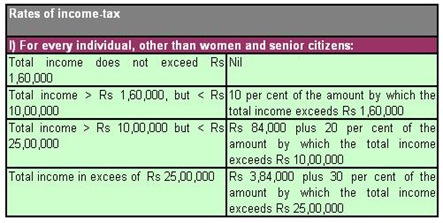
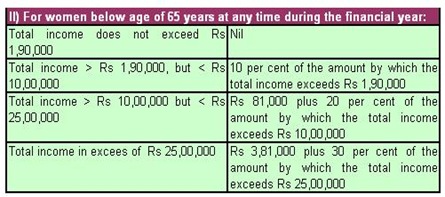
And here comes the New Direct Tax Code Bill, 2009  which attempts to simplify the lives of the tax payers.  Though the bill does not fulfill the wish-list of our discussion, it is surely a step towards providing a more tax-payer  friendly and simplified tax structure.

Following are the brief highlights of the New Direct tax code Bill,2009

  • The objective of the new tax code is to establish an efficient , effective and equitable direct tax structure in the country.
  • All direct taxes like Income Tax, Dividend distribution tax (DDT), Fringe benefit tax (FBT) and Wealth tax will be covered under this single tax code.
  • New Tax Rates will be applicable w.e.f. Financial year 2011 as under

newtaxrate1

newtaxrate2

newtaxrate3

  • Savings will now be taxed on EET basis. This means that Savings when done under designated schemes would be exempt from tax in the year the saving is done (First ‘E”). It will continue to be exempted together with the accumulations/accretions till the time they remain invested (that means till they are not withdrawn, this is Second ‘E’). The savings will be taxable at normal tax rates in the year in which withdrawal is made (this is ‘T’).
  • However, accumulated balances as on 31st March,2011 in the Provident Fund will not be taxed.
  • Deduction on account of savings has been increased from current 1 Lac to 3 Lac. However, since the new code doesn’t mention deduction in respect of Housing loan, the same may go.
  • Dividends will continue to remain tax free in the hands of Investors.
  • Capital Gains would now be taxed as income. The concept of short term and long term capital gains has been removed from tax perspective. Indexation benefit would be available on asset held for more than one year.
  • The indexation base has been changed from 1981 to 2000.
  • Since all capital gains are now taxed, Securities Transaction Tax (STT) has been abolished under the new tax code.
  • Salary received in form of perks, perquisite, LTA, Rent free accommodation, Medical reimbursement will now form part of Income and will be taxable.
  • Wealth Tax has been Re-introduced. Net Wealth in excess of Rs. 50 Crore  will be taxed @0.25%
  • In addition to deduction of Rs 3 Lac for notified savings schemes, Rs 15,000 deduction will be available for Medical Insurance Premium for self and family , and another Rs 15000 for parents. Up to Rs 50,000 can be claimed as deduction for treatment of disabled dependant , Rs 40,000 for prescribed diseases. Rs. 50,000 deduction would be available to handicapped and Rs 75000 for person with severe disability.

The New tax code is in discussion stage. You can give your comments and suggestions on the same by writing an email to directtaxescode-rev@nic.in

Keep a watch on this blog for posts related to implications of new tax code.

Download Discussion Paper

Download Direct Taxes Code Bill, 2009

Read More!

CBEC issues Notification on Excise and Service Tax Reduction

CBEC has issued Notification No. 4/2009 - Central Excise dated 24th February,2009 with regards to the Excise Duty rates reduction announced yesterday by the government.

CBEC has issued Notification No.  8 /2009 – Service Tax dated 24th February,2009 with regards to the Service Tax rates reduction announced yesterday by the government.

Read More!